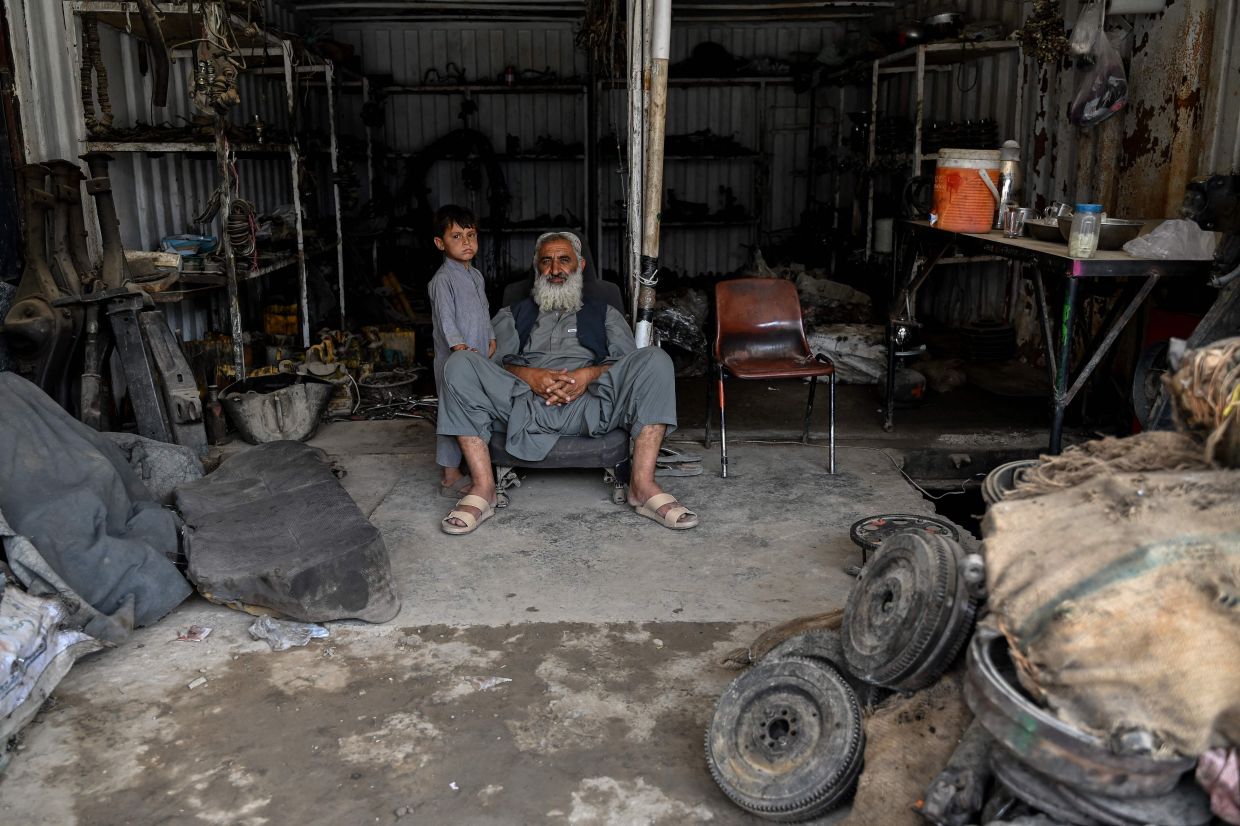
The automotive marketplace in Spin Boldak, nestled in Afghanistan's southern Kandahar province, once hummed with the activity of merchants moving vehicle components across continents. Today, it stands eerily quiet, a casualty of the broader geopolitical instability that has become an inescapable feature of the region. What was once a reliable conduit for Japanese, Middle Eastern, and other international car parts has been systematically dismantled by two successive waves of disruption: first the October closure of the Pakistan border following cross-border violence, and then the February outbreak of conflict in the Middle East that sent shockwaves through global maritime commerce.
The closure of the Pakistan border represented the first major blow to an industry that had developed intricate supply networks over years of operation. For decades, Spin Boldak served as a crucial junction where overland routes from Pakistan converged with local distribution channels, allowing parts to flow steadily into Afghanistan. According to Abdul Baqi Bina, deputy head of the Kandahar Chamber of Commerce and Investment, traders initially scrambled to find workarounds, rerouting shipments through Iran's Bandar Abbas port despite the logistical headaches and increased costs this entailed. The solution was makeshift and expensive, but it allowed the market to continue functioning at reduced capacity. Merchants demonstrated considerable resilience, adapting their operations to this new reality while accepting the squeeze on their profit margins.
That adaptation proved temporary. The eruption of conflict in the Middle East in February delivered what amounts to a knockout blow to these already-struggling traders. The geopolitical crisis sparked unprecedented disruption in the Strait of Hormuz, one of the world's most critical maritime chokepoints through which a substantial portion of global trade passes. Shipping companies and logistics experts have cautioned that returning to normal operations through this waterway will require considerable time, making any near-term recovery unlikely. For Afghanistan's car parts importers, the timing could scarcely have been worse, as they had only recently adjusted their operations following the Pakistan border closure.
The financial impact on importers has been staggering. Container costs, which traders could previously manage at around US$2,000 per unit, have skyrocketed to US$8,000 in the post-February period—a fourfold increase that renders many shipments economically unviable. Asadullah, a Dubai and Japan-based importer working from an office in Spin Boldak, has seen his entire operation paralysed. He reported opening two containers daily at his yard before the conflicts; now he sits with over 30 containers stranded between Japan and the United Arab Emirates, unable to move forward due to gridlock at Dubai's Jebel Ali port, which functions as a critical logistics hub for the entire region. The accumulating storage costs on these stuck shipments represent a haemorrhaging of capital with no corresponding revenue to offset the losses.
Masoud, another parts importer sourcing primarily from Japan, has watched his business evaporate entirely. Where his operation once handled dozens or even hundreds of containers monthly, the current volume has fallen to zero. Facing mounting storage fees in the UAE and no prospect of meaningful sales, he has made the painful decision to reverse-ship containers back to Japan, accepting this as a total financial loss rather than continuing to pay storage charges indefinitely. His resignation is palpable: when asked about alternatives, he simply states there are none. This represents not merely a temporary slowdown but rather a fundamental disruption that has forced merchants to abandon established supply chains and accept catastrophic losses.
The World Bank's assessment in May underscores the precariousness of Afghanistan's overall economic position, which makes the collapse of any major trade sector particularly damaging. The institution characterised Afghanistan as "highly exposed to external shocks," with imports vastly outpacing exports—a gap that reached 70 per cent of GDP in the 2025 fiscal year. The automotive parts trade, which had represented a significant economic activity and foreign exchange earner for the country, now constitutes another drag on an already-strained economy. The breakdown of this particular supply chain illustrates how regional instability transmits directly into economic pain at the local level, affecting everything from employment to government revenues.
The human consequences ripple outward from the importers to the broader ecosystem of workers and entrepreneurs who depend on steady parts supplies. Mohammad Naeem, a 21-year-old crane operator who worked in the Spin Boldak yards, faces the prospect of abandoning his trade entirely if the situation does not improve. Workshop owners like Samiullah, who previously assembled five to seven vehicles weekly, now find themselves unable to work because no parts are arriving. Yet Samiullah must continue paying his employees regardless, creating an unsustainable situation where fixed labour costs persist while revenue streams have vanished. The workshops themselves—the physical infrastructure of the industry—sit dark and idle, their tools and equipment gathering dust as craftspeople wait for supplies that may never come.
Downstream, car dealerships that specialised in vehicles assembled from Japanese imports have also suffered. Noor Ali, who operates a showroom displaying colourful vehicles built from imported components, has not completed a sale in a month. His inventory of finished vehicles represents capital tied up with no buyers appearing, as customers have understandably fled the market given the uncertainty surrounding future supply availability. The ripple effects extend beyond those directly involved in imports and assembly to encompass an entire commercial ecosystem that had built itself around the reliable flow of international automotive components.
The closure of supply lines reveals a deeper vulnerability in Afghanistan's economy: the country's heavy dependence on imports for virtually all manufactured goods, combined with its geographic position making it susceptible to disruptions in distant global chokepoints. When the Strait of Hormuz faces problems, when regional conflicts create security risks, or when neighbouring countries close borders, Afghanistan lacks the industrial capacity or economic diversity to absorb these shocks. The vehicle parts trade employed thousands directly and many more indirectly, yet it now faces an existential threat that no amount of local ingenuity can overcome. The merchants of Spin Boldak can only watch and hope that international shipping returns to normal and that the Strait of Hormuz reopens fully—outcomes entirely beyond their control.

