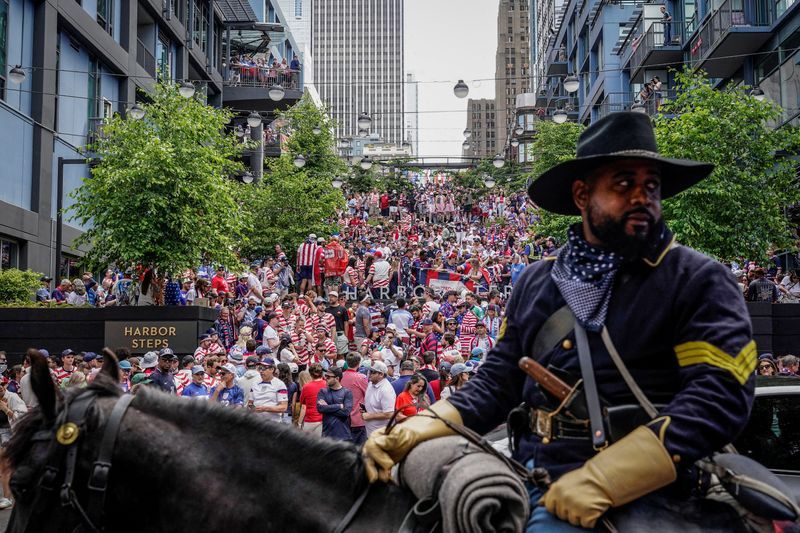
The 2026 FIFA World Cup has scattered itself across sixteen cities spanning Mexico, the United States, and Canada, each location adding its own distinct flavour to football's most universal gathering. What emerges from the testimonies of Reuters photographers embedded throughout the tournament is a portrait not merely of stadiums and matches, but of how the world's most watched sport catalyses something deeper within urban communities—connection, pride, and unexpected solidarity between strangers bound by passion for the game.
In Mexico City, the epicentre of Mexican football culture, photographer Raquel Cunha discovered that the sport's grip extends far beyond the hallowed Estadio Azteca, venue for two World Cup finals. Walking through local neighbourhoods, she found entire communities that had reconfigured their physical geography around the sport, carving out spaces for football pitches wherever space allowed. This geographical transformation speaks to how deeply embedded soccer remains in Mexican urban identity, functioning not as entertainment imported from above but as something woven into the fabric of daily neighbourhood life. For many residents, the World Cup's arrival simply amplified what already existed as an integral part of their world.
Westward to Guadalajara, where historical memory intersects with present celebration. The 1970 appearance of Pele in this western city remains a touchstone for older residents, a moment so significant that a statue honouring the Brazilian legend was unveiled during this tournament. Photographer Ivan Arias observed something equally poignant: the spontaneous friendships that bloomed between Mexican and Colombian supporters. These fans crossed national boundaries to attend each other's celebrations and matches, creating a temporary transnational community where the usual sporting rivalries softened into mutual encouragement. Such moments illustrate how the World Cup, despite its competitive structure, functions simultaneously as a vehicle for unexpected human connection.
Monterrey revealed football's integration into leisure culture itself. Daniel Becerril documented how locals gathered in backyards for barbecues accompanied by cold beers and matches on television, or crowded into neighbourhood bars for collective viewing. This casual domestication of World Cup matches—transforming them from stadium spectacles into intimate social occasions—demonstrates how football adapts itself to local customs rather than imposing uniformity. In each setting, the game becomes a framework for existing social practices.
Miami presented a different dynamic entirely. Amanda Perobelli found that the tournament felt less like an interruption of city life and more like a natural extension of what already existed. The city's substantial Latin American population meant that World Cup fever arrived not as novelty but as intensification of established cultural practices. Yet the Florida heat and humidity posed genuine challenges, testing fans' endurance during long hours of outdoor celebration. Nonetheless, spectators appeared largely undeterred, their enthusiasm sustained despite climatic obstacles.
Texas—both Houston and Dallas—embodied American excess. Phil Noble captured the vastness that characterised the experience: massive stadium capacities, enormous serving portions of barbecue, six-lane highways, and a scale of hospitality extended generously to visiting supporters. Mexican-shirted fans permeated these cities, and strikingly, locals often cheered for visiting nations when the United States wasn't playing. Hannah McKay similarly marvelled at Texas's scale and the packed stadiums where Lionel Messi established his men's World Cup goal-scoring record, creating atmospheric moments that transcended ordinary sporting drama.
Atlanta's retractable roof and unconventional stadium design didn't diminish the palpable energy Claudia Greco documented throughout the Southern city. Fan zones operated at capacity, restaurants broadcast matches, and commercial establishments reported booming business. The tournament catalysed economic activity while simultaneously creating public gathering spaces where the entire city seemed momentarily unified in common cause. Los Angeles, a sprawling metropolis of discrete neighbourhoods, experienced something subtly different: the World Cup drew residents out from their customary vehicular isolation and into streets as pedestrians and community members. Daniel Cole witnessed Iranian, South Korean, and Mexican diasporas celebrating their ancestral nations, using the tournament as occasion for cultural expression that extended beyond football itself.
San Francisco's experience, as documented by Carlos Barria, carried particular significance. Immigrant communities embraced their countries of origin—displaying flags, speaking native languages, and sharing traditional foods—at a moment when U.S. migration policies had created tension within such communities. The World Cup provided temporary sanctuaries where cultural identity could be celebrated rather than contested. Simultaneously, American spectators encountered cultures and traditions they might otherwise never experience, creating the kind of genuine cultural exchange that transcends tourism or performance. This reciprocal discovery, Barria suggests, represents what the beautiful game fundamentally offers.
Kansas City, straddling the Kansas-Missouri border, revealed itself as a city where multiple sporting traditions coexist harmoniously. Baseball, American football, and soccer all claimed cultural space, finding enthusiastic audiences. Kai Pfaffenbach observed overwhelmingly positive atmospheres as people gathered primarily to enjoy themselves and celebrate collective participation in the game. The World Cup became pretext for social assembly rather than divisive competition.
Philadelphia presented a curious contrast to experiences elsewhere. Siphiwe Sibeko, accustomed to South African contexts where football tournaments utterly dominate public consciousness and conversation, found Philadelphia's World Cup presence surprisingly muted. Away from match day and the stadium vicinity, one could forget the tournament existed at all. This subdued atmosphere reflected American sporting culture's compartmentalisation, where even major tournaments occupy limited temporal and spatial territory rather than permeating entire cities.
New York embodied continuous spectacle. Dylan Martinez documented Norwegian fans performing their Viking row chants while Latin American supporters flooded Times Square for banderazos—coordinated fan celebrations. Coincidentally, the Knicks claimed their first NBA championship in over fifty years during the tournament, overlaying football with basketball fever. The city lived up to its reputation as one that never sleeps, with multiple sporting dramas unfolding simultaneously.
Boston held particular resonance for photographer Brian Snyder, who had covered the 1994 World Cup when the United States last hosted the tournament. He detected a marked difference: substantially greater fan engagement and public enthusiasm than thirty-two years earlier. Beyond the well-publicised embrace of Scotland's Tartan Army, Snyder observed Haitian, Moroccan, and Cape Verdean communities enthusiastically supporting their nations, suggesting deeper integration of immigrant communities into broader public celebration.
Toronto offered unexpected wildlife encounters when Bernadett Szabo nearly collided with a falcon near the stadium, discovering that a falcon family—parents and four chicks—resided at the venue. Such unscripted moments remind us that hosting major tournaments involves negotiating human celebration with existing ecosystems and urban fauna. Finally, Vancouver and Seattle represented contrasting Pacific responses: Vancouver seemed less obviously transformed by the tournament's presence, with subdued atmosphere requiring effort to locate, while Seattle embraced festive street celebrations and the American conception of sports as complete entertainment experiences, complete with coordinated fan attire and extensive food concessions that turned attendance into comprehensive experience design.

