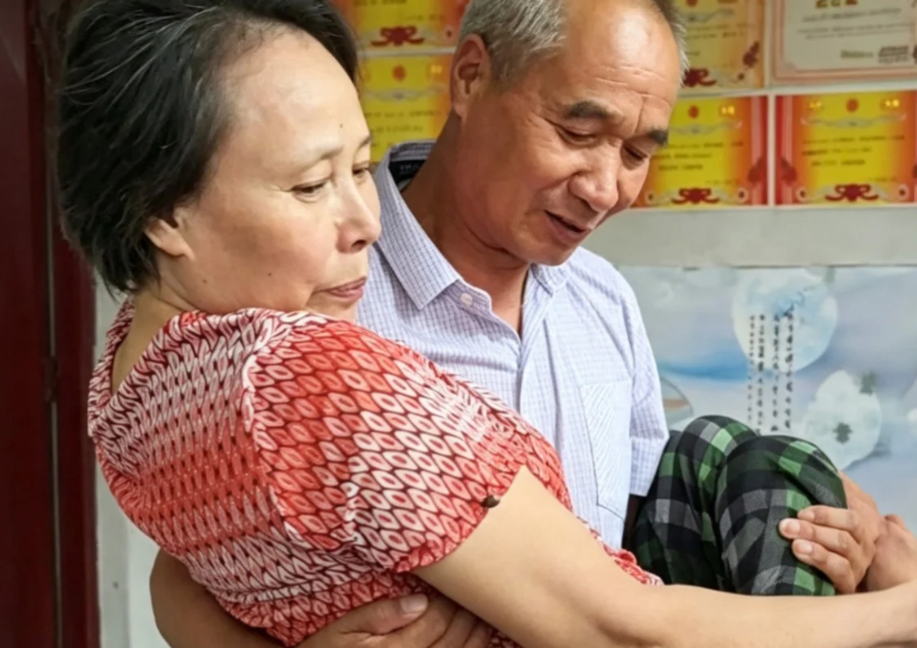
In the heart of Henan province, a remarkable tale of marital devotion has captivated audiences across mainland China, reminding viewers of the profound ways commitment can sustain families through extraordinary hardship. Li Junliang and his wife Jia Fang, residents of Pingdingshan, have spent the past quarter-century navigating life together after a tragic accident transformed their family's trajectory in ways neither could have imagined. Their story, which has circulated widely on social media platforms throughout the country, illustrates the resilience required when love is tested by catastrophe.
Jia's life changed irrevocably in 2001 when, at age 36, she suffered a devastating fall from a cliff while riding a pedicab. The accident left her paralyzed from the chest downward, robbing her of physical independence and fundamentally altering the family's daily existence. At the time of her injury, their two children were merely ten and thirteen years old, adding another layer of complexity to an already overwhelming situation. Rather than buckle under the weight of these circumstances, Li resolved to become the pillar upon which his family would rely, setting aside any personal aspirations to focus entirely on his wife's care and their children's wellbeing.
The physical demands of Li's caregiving role have been relentless and unforgiving. In the early years following Jia's accident, he developed meticulous protocols to preserve her health, turning her body every two hours throughout the day and night to prevent the development of pressure ulcers—a common and serious complication among paralyzed patients. Over time, he adjusted this routine to every four hours, yet this modification offered him little relief, as he has effectively forgone uninterrupted sleep for two decades. The cumulative toll of this endless vigilance is visible in his appearance; his hair has turned completely grey while Jia's remains predominantly black, a physical testament to the stress his body has endured.
Beyond the mechanical aspects of physical care, Li has committed himself to maintaining Jia's dignity and quality of life. He regularly transfers her to a wheelchair, wheeling her outside to experience sunshine and breathe fresh air—simple pleasures that require significant effort but carry enormous psychological value for someone confined to bed. His hands have become instruments of therapeutic care, regularly massaging her limbs to combat the muscular atrophy that inevitably accompanies paralysis. These acts, performed daily without complaint or expectation of recognition, represent the quiet heroism that characterizes his approach to spousal care.
The couple's children, who could have become resentful of the burden their mother's condition imposed on family life, instead witnessed an extraordinary example of commitment and responsibility. Both children have since matured into adults who have established their own families, a testament to the stable, nurturing environment Li maintained despite the overwhelming circumstances. The walls of their home display certificates of academic achievement from the children's school years, silent proof that Li managed to balance his wife's intensive care needs with parental involvement in his children's education and development.
Jia's own perspective on her husband's dedication reveals the emotional foundation underlying their survival. Speaking to media, she expressed wonder at how her husband has managed to shoulder such an enormous burden for so long. Her observation that his hair has greyed while hers has not underscores the asymmetrical toll their circumstances have extracted. Yet her gratitude transcends practical acknowledgment; she has publicly declared her belief that she married the right man, attributing her happiness to his unwavering presence and commitment. This emotional reciprocity—her recognition of his sacrifice combined with her continued affection—appears to sustain Li in ways material compensation never could.
Li's response to his wife's expressions of gratitude reveals the philosophical foundation of his caregiving. He frames his actions not as burden or obligation, but as the fulfillment of a promise made on their wedding day: that their home would be complete only with her presence. He has vowed to continue his care for another 25, 35, or even 45 years, suggesting that his commitment transcends the years already invested. This perspective—viewing caregiving as an expression of love rather than a hardship imposed by circumstance—may explain how he has sustained such dedication without apparent bitterness or resentment.
The couple's story resonates particularly powerfully in contemporary China, where traditional values emphasizing familial duty and marital commitment remain culturally significant despite rapid modernization. For many observers, Li represents an increasingly uncommon figure: a man who has prioritized family obligations over personal advancement, demonstrating that alternative measures of success and fulfillment exist beyond professional achievement or material accumulation. The widespread social media engagement with their story suggests a hunger among Chinese audiences for narratives that celebrate enduring commitment and human kindness.
Neighbours and online commentators have praised Li not merely for his caregiving but for the overall quality of family life he has maintained. One neighbour specifically noted the cleanliness and tidiness of their home, suggesting that Li has managed to preserve standards of dignity and order despite the overwhelming practical challenges. This observation highlights how his care extends beyond medical necessity to encompass the psychological environment within which his wife lives. For someone with limited physical autonomy, the quality of one's immediate surroundings becomes exponentially important, and Li's attention to this dimension reveals sophisticated understanding of what meaningful care entails.
The couple's experience also illuminates the broader question of healthcare and social support systems in rural China. The report does not clarify Li's profession or the economic means through which the family sustains itself, raising questions about how many families in similar circumstances lack such devoted caregivers. The implicit contrast—between families blessed with someone like Li and those without—underscores potential gaps in formal healthcare provision and social welfare systems. While their story celebrates individual virtue, it also implicitly raises concerns about equity and access to care for disabled individuals whose families may lack the resources or commitment that characterizes this remarkable partnership.
As Li and Jia's story continues to circulate online, it has inspired reflection on the nature of commitment, sacrifice, and love in contemporary society. Their quarter-century together challenges cultural narratives suggesting that modern life necessarily prioritizes individual satisfaction over relational commitment. For Malaysian and Southeast Asian readers, the story offers a mirror in which to examine their own cultural values around family responsibility and the expectations placed on spouses. Whether one views Li's dedication as inspiring or cautionary depends partly on one's perspective on gender roles, caregiving burdens, and the proper balance between individual rights and family obligations—questions that remain contested across the region.
Ultimately, Li and Jia's enduring relationship demonstrates that meaning and fulfillment can emerge from the most challenging circumstances when sustained by genuine affection and shared commitment. Their story does not minimize the hardship inherent in their situation nor suggest that such sacrifice should be expected or demanded. Rather, it offers a portrait of how two people have chosen to meet catastrophe not with despair but with creativity, devotion, and an insistence on maintaining dignity and love despite circumstances that could easily have led to abandonment or institutionalization. In an era often characterized by skepticism about lasting commitment, their quarter-century together stands as a quiet testimony to enduring human connection.

