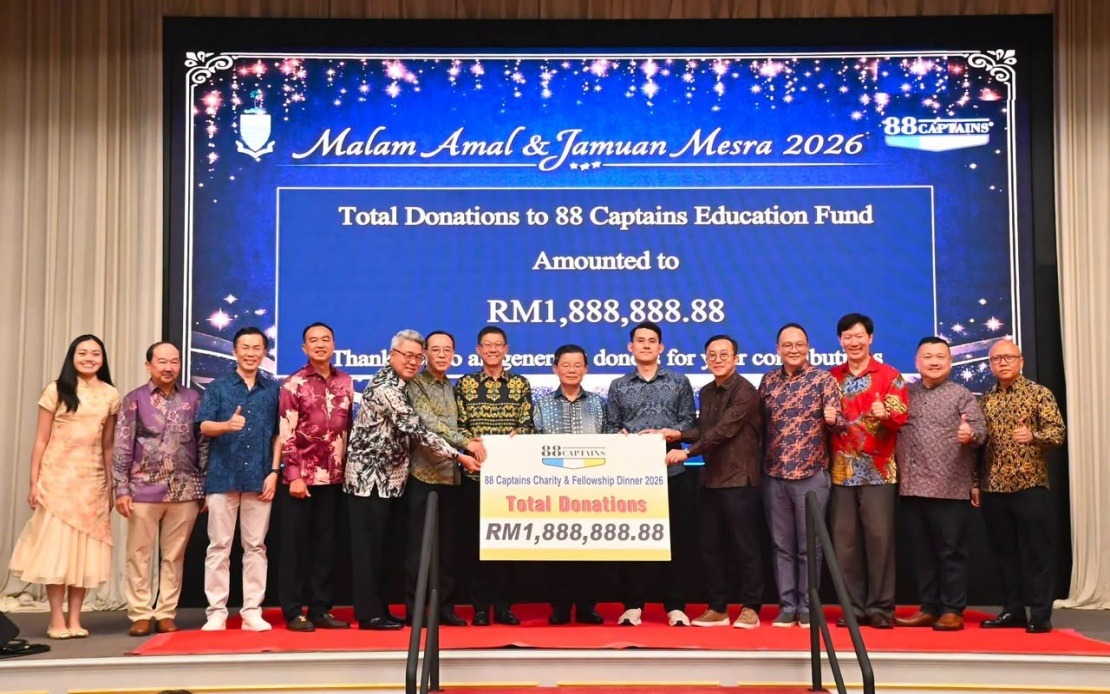
The Persatuan Kebajikan 88 Kapten Pulau Pinang has distributed scholarships exceeding RM1 million to 44 students across five educational institutions in Penang, marking the latest phase of the charity's commitment to nurturing young talent and strengthening the region's human capital. The awards were announced at the organisation's Annual Charity Dinner 2026 in George Town, an event that also drew substantial financial support from the business community, with total fundraising reaching RM1.89 million. The timing reflects growing recognition among Malaysian business leaders that investment in education and workforce development yields long-term returns for regional economic competitiveness.
According to Datuk Seri Dr Ooi Eng Hock, chairman of 88 Captains, the scholarship initiative extends beyond conventional financial relief. Rather than viewing these grants merely as solutions to immediate hardship, the organisation positions them as catalysts for ambition and character development. The implicit message resonates with current Malaysian policy discourse on producing graduates who possess not only technical qualifications but also a commitment to contributing meaningfully to society. This philosophy aligns with broader national efforts to shift the focus in tertiary education from credential accumulation to cultivation of responsible, purpose-driven citizens.
Central to 88 Captains' strategy is the Apprenticeship, Internship, Reskilling and Upskilling (AIRU) programme, which commenced operations last year at Universiti Sains Malaysia. This initiative directly addresses a persistent tension in Southeast Asian labour markets: the mismatch between what universities teach and what employers actually require. By formalising dialogue between academic institutions and industry leaders through a dedicated task force comprising high-achieving students from USM, ViTrox College, Tunku Abdul Rahman University of Management and Technology, and INTI International University, the programme creates structured channels for honest conversation about workplace readiness. The emphasis on minimum starting salary expectations of RM4,000 for graduates signals an attempt to anchor these discussions in economic realities rather than theoretical frameworks.
Penang Chief Minister Chow Kon Yeow's public endorsement of the initiative underscores its strategic importance to state-level economic planning. The AIRU programme's focus on bridging academia and industry directly supports Penang's declared ambitions to establish itself as a hub for advanced manufacturing, semiconductors, artificial intelligence, and digital economy activities. These sectors demand workforces with sophisticated skill sets and the capacity for continuous learning—precisely the outcomes that education-industry partnerships seek to deliver. By championing such programmes, Penang positions itself competitively within Malaysia's regional hierarchy of technology and innovation centres.
Beyond scholarships and industry partnerships, 88 Captains has accumulated an impressive track record of educational infrastructure investment. Over four years, the organisation has orchestrated more than 50 separate events and community projects, ranging from donating smart televisions to schools—a seemingly simple gesture that nevertheless extends digital access to resource-constrained institutions—to establishing 5G Education Digital Libraries across 88 schools. These initiatives address the digital divide that persists in Malaysian education, particularly in smaller towns and rural areas where school budgets struggle to accommodate modern learning technologies. The organisation's support for the Special Education Integration Programme demonstrates recognition that talent development must remain inclusive, ensuring that students with diverse learning needs are not left behind in the race for skills and opportunity.
A particularly noteworthy recent initiative involves the Joint Mental Health Development in Schools with AI Early Education for Responsible Adoption, launched earlier this week. This programme arrives at a critical juncture in Malaysian education policy, following the introduction of the Anti-Bullying Act 2026. While legislative frameworks provide necessary guardrails, preventing harm requires active, proactive measures embedded within school culture. By combining mental health support with responsible AI literacy, 88 Captains tackles two overlapping contemporary challenges: the mental wellbeing crisis affecting Malaysian youth and the urgent need to prepare young people to navigate increasingly AI-mediated environments wisely. This programme implicitly recognises that technology adoption without corresponding ethical and psychological preparation can compound rather than solve educational challenges.
Chow's remarks about the Anti-Bullying Act underscore a broader principle applicable across Southeast Asia: laws provide frameworks, but cultural transformation depends on schools, families, and communities. The 88 Captains initiative invites teachers to become active partners in prevention rather than passive administrators of rules. This approach distributes responsibility for student wellbeing across multiple stakeholders rather than concentrating it solely within a legal enforcement system. For Malaysian educators stretched across resource-limited institutions, such partnership models can prove invaluable, offering practical support and expert guidance that standalone legislation cannot provide.
Established in 2022, 88 Captains represents a relatively recent but strategically focused addition to Penang's charitable ecosystem. Its formation reflects recognition among business leaders that sustainable regional development requires deliberate investment in the next generation's capabilities and character. The organisation's geographic focus on Penang and the Northern Region demonstrates how philanthropic efforts can concentrate resources in areas perceived as growth corridors, potentially reinforcing existing economic advantages. For leaders in other Malaysian states and ASEAN countries, the 88 Captains model offers an instructive blueprint: structured, sector-specific engagement between business and education can produce measurable outcomes in talent development while strengthening alignment between workforce supply and industry demand.
The RM1.89 million raised at the latest charity dinner illustrates the financial capacity of Penang's business community to mobilise capital for education purposes. This fundraising success, achieved despite Malaysia's complex economic environment, suggests that corporate leaders perceive education investment as aligned with enlightened self-interest. A workforce equipped with relevant skills, mental resilience, and ethical grounding directly benefits the companies that employ them. This convergence between philanthropic impulse and economic self-interest creates durability: unlike aid dependent on changing government budgets or international donor priorities, business-led education initiatives can sustain themselves through ongoing commitment from profit-generating enterprises.
The presence of Penang Governor Tun Ramli Ngah Talib and Chief Minister Chow Kon Yeow at the charity dinner signals official validation of 88 Captains' work and implicitly encourages other business organisations to adopt similar models. In Malaysia's federal system, where state governments maintain significant autonomy over education policy and workforce development strategy, such public endorsements carry weight. They position education philanthropy as not merely a charitable activity but as a state development priority, potentially encouraging additional corporate participation and larger donations from other business entities seeking alignment with government priorities.
Looking forward, the expansion of the AIRU programme to additional universities and the scaling of the mental health initiative across more schools will determine whether 88 Captains can transition from a promising beginning into a transformative force within Penang's education ecosystem. The challenge lies in maintaining programme quality while expanding reach, and in sustaining funding commitments through changing business cycles. Success would demonstrate that coordinated public-private partnerships can address the twin imperatives of economic competitiveness and holistic human development—a model increasingly relevant as Malaysian policymakers grapple with skills gaps, youth mental health challenges, and the need to compete in rapidly evolving global markets.

