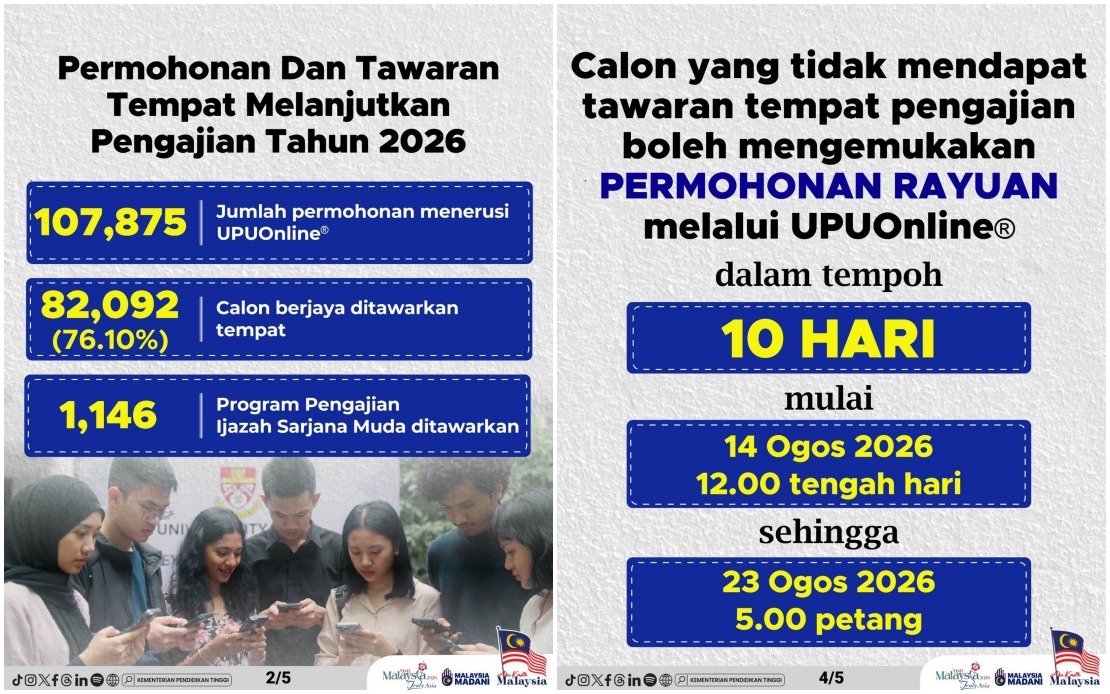
The Ministry of Higher Education (KPT) has announced that 82,092 candidates have secured undergraduate admission to Malaysia's 20 public universities for the current academic session, marking a significant milestone in the nation's higher education intake process. This figure, disclosed in Putrajaya on August 14, reflects the successful placement of 76.10 per cent of the 107,875 applicants who met the eligibility criteria for undergraduate study through the UPUOnline system, the centralised admission portal that processes all applications to public tertiary institutions.
The scale of this year's undergraduate intake demonstrates the continued capacity of Malaysia's public university system to absorb a substantial portion of the nation's school leavers and eligible applicants seeking tertiary qualification. Across the 20 participating institutions, a combined total of 1,146 bachelor's degree programmes have been made available for this intake cycle, spanning disciplines from engineering and medicine to humanities, social sciences, and creative fields. This breadth of offerings reflects efforts to align university provision with both labour market demands and diverse student aspirations across the country.
Admissions decisions have been determined strictly according to meritocratic principles, with the KPT emphasising that all eligible applicants were ranked according to their calculated merit scores in descending order. This transparent, scores-based methodology has become the cornerstone of public university admission policy in Malaysia, intended to ensure fairness and consistency across the diverse applicant pool while rewarding academic achievement. The merit-based system replaces earlier, more opaque allocation methods and has gained broad acceptance among educational stakeholders as a mechanism for identifying the strongest candidates across socioeconomic backgrounds.
For Malaysian students and families, the announcement carries both positive and challenging dimensions. The acceptance rate of approximately 76 per cent provides reasonable odds for eligible applicants, though it also means that roughly one-quarter of those who met baseline requirements will not secure placement in this intake round. The competitive nature of public university admission reflects sustained demand for tertiary education among Malaysian students, driven by recognising higher qualifications as essential for professional advancement and economic mobility in an increasingly knowledge-intensive job market.
The ministry has extended congratulations to all successful candidates, urging them to maximise the opportunity to pursue higher education as a foundation for future career development and personal growth. This language underscores the government's framing of university education as a privilege and responsibility, particularly given the subsidised nature of public university provision in Malaysia, where tuition fees remain substantially lower than comparable private institutions or overseas study options.
Crucially, the admission process does not conclude with this primary allocation round. The KPT has instituted an appeal mechanism for candidates who did not receive placement offers, recognising that merit scores alone may not capture all dimensions of student potential or that administrative or clerical issues might require review. This appeals window operates through the UPUOnline portal over a ten-day period, commencing at noon on August 14 and closing at 5 pm on August 23, 2026, providing unsuccessful applicants with a formal second opportunity to contest their outcomes or seek reconsideration.
The availability of an appeals process reflects international best practice in higher education admission and demonstrates responsiveness to concerns about access and fairness. Students or their parents who believe errors occurred in the processing of their application, or who wish to provide additional context regarding their circumstances, can lodge formal appeals during this window. However, successful appeals typically require compelling documentation or evidence of material procedural irregularities, rather than requests for re-scoring based on subjective factors.
For those who exhaust the public university system through both the primary intake and appeals processes, alternative pathways to tertiary qualification remain available. Malaysia's private university sector, which includes both local institutions and offshore branch campuses of international universities, provides parallel routes to degrees. Additionally, students may defer university entry and reapply in subsequent years, pursue vocational or diploma qualifications through polytechnics or community colleges, or consider study abroad options. The existence of these alternatives means that this year's public university admission, while significant, does not represent a final closure of educational opportunity for unsuccessful applicants.
From a regional perspective, Malaysia's structured approach to mass undergraduate admissions mirrors systems adopted across Southeast Asia, where governments seek to expand access to higher education while maintaining standards through merit-based selection. However, questions persist across the region regarding whether merit-based systems adequately account for structural inequalities in school quality and educational preparation. Students from well-resourced schools in urban areas typically score higher on standardised assessments than equally capable peers from under-resourced rural institutions, potentially skewing admission outcomes.
The announcement arrives amid broader discussions within Malaysia regarding the relevance of university qualifications to employment outcomes and industry needs. Employers in diverse sectors report skills gaps among graduates, prompting recommendations that universities strengthen linkages with industry and emphasise practical competencies alongside disciplinary knowledge. The high volume of undergraduate places offered—82,092 across 1,146 programmes—suggests ongoing expansion of tertiary capacity, yet policymakers face pressure to ensure that this quantitative growth translates into quality outcomes that genuinely enhance graduate employability and societal contribution.
The admission cycle also reflects demographic patterns within Malaysia's student population. Consistent female over-representation among undergraduate applicants continues, with women comprising roughly 60 per cent of successful candidates in recent years. This trend, observed across Malaysia and many global contexts, raises questions about male educational attainment and career pathways, prompting some academic and policy interest in understanding and addressing potential disengagement among male students from tertiary education.
Moving forward, successful applicants must navigate enrolment procedures, accommodation arrangements, and course registration during the weeks ahead. Universities have typically commenced orientation programmes to support incoming students, particularly given the transition from secondary to tertiary environments. For the broader society, this cohort of 82,092 newly admitted undergraduates represents future professionals, entrepreneurs, and leaders who will shape Malaysia's economic and social trajectory over the coming decades, underscoring the significance of higher education investment to national development.

