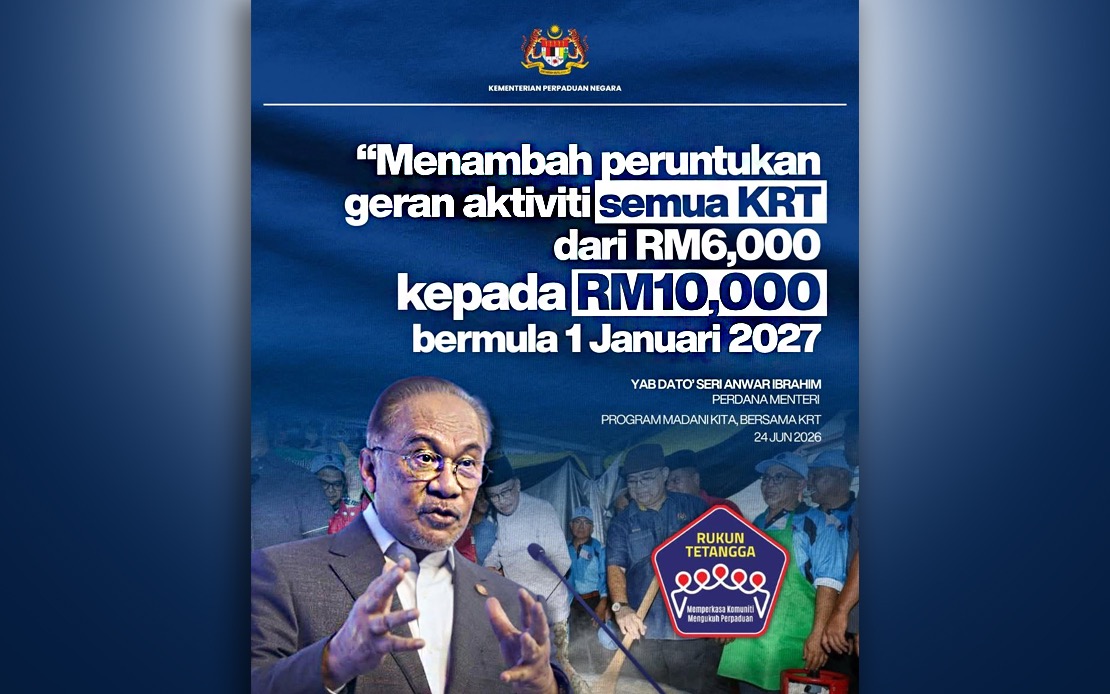
Malaysia's grassroots community framework has received a substantial financial boost with the announcement that annual grants to neighbourhood watch areas, known as KRT, will increase from RM6,000 to RM10,000 nationwide. The hike, representing a 67 percent increase, was disclosed by Prime Minister Datuk Seri Anwar Ibrahim during the MADANI KITA programme in Dataran Segamat, Johor, on June 24, with disbursements set to commence from January 1, 2027. The decision to elevate funding for all 8,615 registered KRT groups reflects the government's strategic pivot towards reinforcing community-level institutions as anchors of national stability and social cohesion.
National Unity Minister Datuk Aaron Ago Dagang characterised the grant increase as recognition of KRT's enduring institutional significance within Malaysian society. Over more than five decades, these neighbourhood-based organisations have functioned as grassroots platforms for fostering interethnic cooperation, managing local disputes, and coordinating community welfare initiatives. The ministry's framing of this budgetary decision underscores an implicit acknowledgment that sustainable national unity requires sustained investment in the organisational infrastructure that enables day-to-day interpersonal interaction across demographic boundaries. By enhancing KRT's financial capacity, the government effectively signals that grassroots social engineering remains integral to the MADANI governance framework.
The scale of KRT's operational reach is considerable. Approximately 250,000 registered members operate within these neighbourhood structures, collectively serving more than 12 million Malaysians. During the preceding twelve months alone, KRT groups had coordinated over 100,000 community activities, translating to an impressive frequency of local engagement. This data suggests that KRT membership encompasses roughly 0.8 percent of Malaysia's population, yet their programmatic footprint extends to approximately 40 percent of citizens, indicating substantial multiplier effects through family networks and neighbourhood participation. The grant increase therefore carries implications for an extensive portion of the Malaysian populace, particularly those residing in residential areas where KRT maintains active chapters.
The purported applications for additional funding span multiple domains of community governance. Unity activities represent one designated usage category, encompassing interfaith dialogues, multicultural celebrations, and joint neighbourhood projects that transcend sectarian lines. Community development initiatives typically include local infrastructure improvements, skills training programmes, and cooperative economic ventures. Welfare components address vulnerable populations through assistance schemes, eldercare coordination, and emergency support. Educational programming leverages neighbourhood platforms for literacy initiatives, youth mentoring, and vocational awareness. Neighbourhood security functions encompass safety patrols, crime prevention partnerships with local police, volunteerism coordination, and community-based dispute resolution. Local economic empowerment efforts facilitate small business networking, cooperative marketing, and supplier linkages among residents.
From a Malaysian governance perspective, the timing of this announcement carries significance. Released during an election cycle where community sentiment substantially influences electoral outcomes, the grant increase demonstrates tangible commitment to grassroots constituencies. The January 2027 implementation date positions the enhanced funding to take effect during the latter portion of the current parliamentary term, potentially enabling KRT groups to conduct visible programmes during a strategically important period. For policymakers, increased KRT funding represents a relatively cost-effective mechanism for state presence at neighbourhood level, delegating implementation responsibilities to volunteer structures rather than expanding bureaucratic apparatus.
The MADANI framework explicitly positions grassroots movements as foundational to building united and progressive societies. This ideological commitment translates into resource allocation decisions that prioritise enabling community institutions over centralised service delivery. By empowering 8,615 KRT groups with enhanced budgets, the government effectively disperses development authority to neighbourhood level, where organisational legitimacy derives from direct community membership rather than state appointment. This subsidiarity approach reflects contemporary governance trends toward decentralised implementation while maintaining macroeconomic oversight at federal level.
Minister Aaron's emphasis on neighbourliness as the cornerstone of national unity articulates a philosophical position that Malaysia's greatest vulnerability lies not at macro-institutional levels but at interpersonal interfaces. In a plural society comprising multiple ethnic communities, religions, and socioeconomic classes, the routine quality of neighbourhood relations determines whether demographic diversity generates social cohesion or latent tension. KRT organisations represent institutionalised mechanisms for habituating cross-community interaction, building trust through repeated positive encounters, and establishing collaborative problem-solving norms at the most intimate level of civic organisation. The grant increase essentially invests in these routine interactions as genuine national security infrastructure.
For neighbourhood-level stakeholders, the RM4,000 annual increment provides meaningful additional operational flexibility. Previous budgetary constraints often forced KRT groups to prioritise certain activities while deferring others. Enhanced funding enables simultaneous pursuit of multiple programmatic tracks, reduces dependency on external donations for basic operations, and potentially attracts higher-calibre volunteer leadership by enabling more professional programme implementation. The increase also adjusts for inflation that has eroded purchasing power of the RM6,000 grant over preceding years, particularly for groups operating in urban areas where operational costs exceed rural equivalents substantially.
Regional implications deserve consideration within Southeast Asian context. Malaysia's approach to grassroots community strengthening through targeted financial support contrasts with some neighbouring approaches that emphasise either market-driven community development or state-directed programmes. The KRT model, combining volunteer membership with government funding, demonstrates hybrid governance that may interest policymakers throughout the region navigating similar multiethnic, multicultural societies. Countries such as Indonesia, Thailand, and Myanmar confront comparable community fragmentation challenges and may examine Malaysia's KRT experience as instructive for their own neighbourhood-level institutional development.
Ministry oversight mechanisms will determine whether increased funding translates into proportionately enhanced community outcomes. The statement indicates government commitment to ensuring optimal utilisation of additional resources, yet implementation details remain unspecified in public pronouncements. Transparency requirements, accountability benchmarks, and performance metrics should ideally accompany budgetary increases to prevent fungible usage or misallocation. The window between announcement and January 2027 implementation provides opportunity for establishing robust monitoring frameworks that preserve KRT autonomy while ensuring public resources achieve intended community benefits.
The grant increase symbolises broader government conviction that social cohesion requires continuous maintenance through institutional investment and resource allocation decisions that privilege community-level rather than exclusively national-level institutions. Sustained neighbourhood unity depends not merely on exhortations toward interethnic cooperation but on enabling the organisational capacity through which such cooperation materialises. By elevating KRT funding, the MADANI government implicitly acknowledges that Malaysia's unity ultimately rests upon the countless small interactions occurring daily across 8,615 neighbourhoods, where volunteers work to ensure diverse residents view one another as fellow community members rather than representatives of competing groups. This fundamentally grassroots approach to national stability represents a distinctive governance orientation within contemporary Malaysian context.