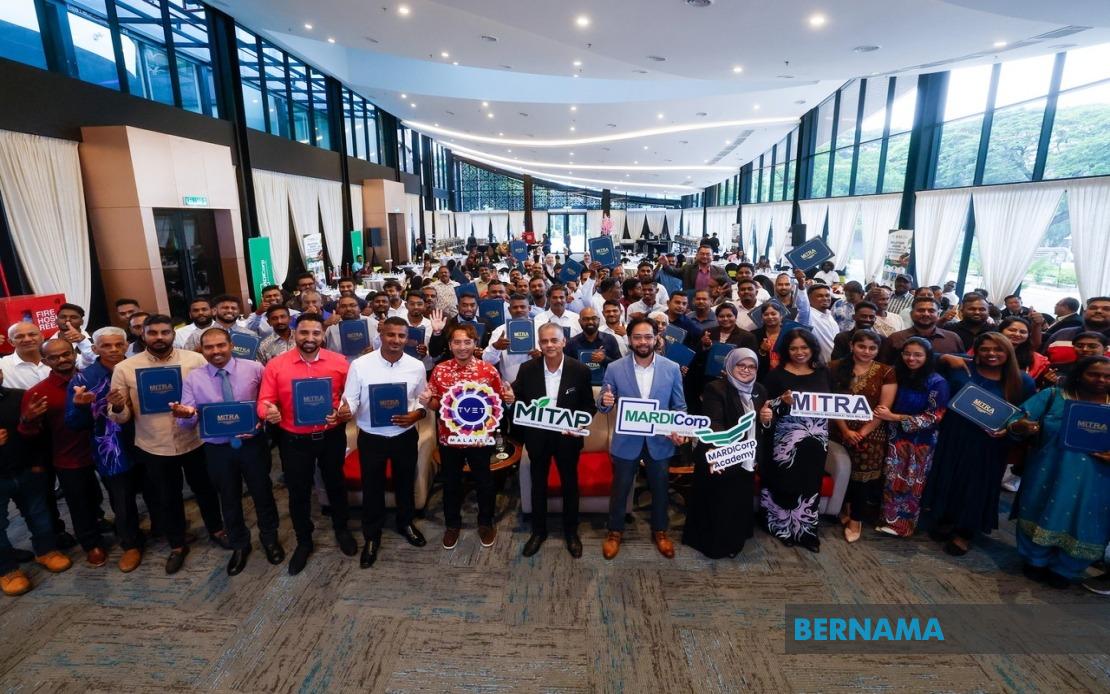
The Malaysian Indian Community Transformation Unit (MITRA) has distributed RM2.04 million in agricultural grants to 68 young entrepreneurs, signalling a concerted push to diversify economic participation within the Indian community beyond traditional sectors. The grants, each valued at RM30,000, were presented at a ceremony in Putrajaya as part of the Malaysian Indian Transformative Agri Programme (MITAP), which aims to position agriculture as a viable career pathway for younger Indians in Malaysia.
MITRA's initiative represents a strategic response to demographic and economic trends within the Indian community. By channelling young people into farming and agribusiness, the programme addresses both underrepresentation in the agricultural sector and the need for sustainable income generation among Indian Malaysians. The RM30,000 grant amount is structured to cover initial capital requirements for small-scale farming operations, from equipment purchases to land preparation, providing a meaningful entry point for first-time entrepreneurs.
The MITAP framework encompasses two distinct but complementary components designed to build a pipeline of skilled agricultural professionals. The QuickWin MITRA stream, which funded the 68 recipients announced this week, emphasises rapid deployment of capital to get young farmers operational. In parallel, the Young Agropreneur Programme (PUM) operates as a more intensive 10-month training initiative that has thus far seen eight participants complete its curriculum. This dual-track approach recognises that capital alone is insufficient; aspiring farmers require technical knowledge, business acumen, and mentorship to succeed.
Implementation of MITAP involves coordination between MITRA and MARDICorp, the research and development arm of Malaysia's Ministry of Agriculture. This partnership is significant because it ensures that grant recipients gain access to evidence-based farming techniques, certified seed varieties, and pest management protocols developed through government research. Rather than operating in isolation, young farmers funded through MITAP become integrated into a support ecosystem that includes extension services and technology transfer opportunities.
The agricultural activities supported under MITAP reflect both traditional farming interests and emerging opportunities within the sector. Food crop production dominates, providing stability and food security benefits, but the programme also backs dairy cattle management, which offers higher-value output and requires sustained investment. Beekeeping and oyster mushroom cultivation attract younger farmers seeking lower land-intensity models, while freshwater fish farming appeals to those with water access on their properties. The inclusion of food processing technology reflects market realities; value-added production often generates superior margins compared to raw commodity sales.
MARDICorp's commitment to post-grant support addresses a critical gap in many agricultural development programmes. Young agropeneurs frequently struggle not with production but with market access and commercialisation. By explicitly assisting with produce marketing, developing downstream products, and facilitating technology adoption, MARDICorp helps farmers transition from subsistence to commercial operations. The involvement of the corporation's managing director, Mohamad Zamir Ghazali, in presenting the programme underscores institutional commitment beyond symbolic gestures.
The networking and association dimensions embedded within MITAP deserve particular emphasis. Young farmers operating individually face significant disadvantages in negotiating with input suppliers and securing reasonable output prices. By encouraging MITAP participants to join agricultural associations, the programme creates collective bargaining power and knowledge-sharing mechanisms. Some recipients have already formalised these memberships, indicating early adoption of cooperative frameworks that historically strengthen smallholder agriculture across Southeast Asia.
For Malaysia's broader agricultural landscape, the MITAP initiative signals important demographic shifts. The farming sector has long struggled with an ageing population; attracting younger participants, particularly from communities previously peripheral to agriculture, expands the potential workforce and introduces fresh entrepreneurial perspectives. Young farmers often display greater willingness to adopt mechanisation, digital tools, and sustainable practices compared to their older counterparts, potentially accelerating sectoral modernisation.
From a communal perspective, the programme addresses socioeconomic disparities that have historically limited economic mobility for Indian Malaysians. Agriculture, despite its challenges, offers a scalable pathway to asset accumulation and wealth creation. Successful farming businesses generate retained earnings that can fund expansion, family education, and capital investment in other ventures, creating positive intergenerational effects.
The implications for regional agricultural development are also noteworthy. Southeast Asian countries increasingly recognise that inclusive agribusiness development requires targeted support for underrepresented populations. Malaysia's approach, combining capital, training, mentorship, and market linkages, provides a replicable model that other nations and communities might adapt. The emphasis on food security crops alongside higher-value activities balances nutritional resilience with commercial viability, a balance many development programmes struggle to achieve.
Moving forward, the success of MITAP will depend on retention and scaling outcomes. Initial grant absorption is measurable, but whether recipients sustain operations beyond two years and graduate to accessing commercial credit remains to be seen. Government oversight through MARDICorp and MITRA should include systematic monitoring of business survival rates, income generation, and expansion ambitions. Such data would inform refinements to future cycles of the programme and demonstrate accountability to both beneficiaries and taxpayers. If MITAP achieves strong persistence rates and profitability among its cohort, it could become a template for similar community-targeted agricultural development initiatives across Malaysia.

