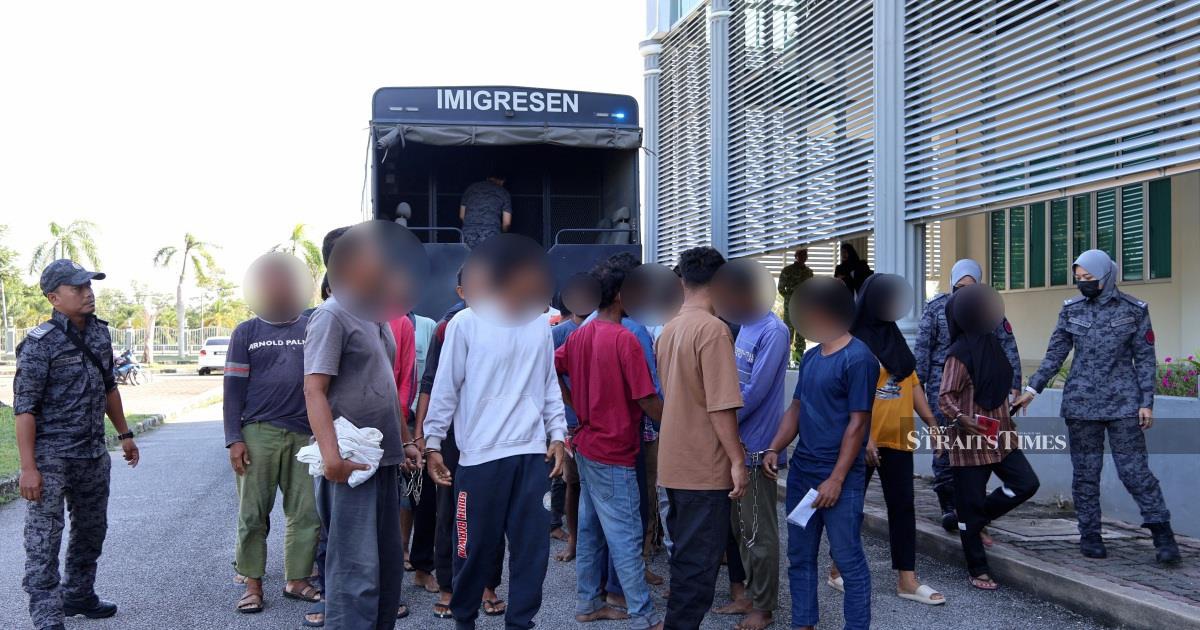
The Pasir Mas Sessions Court meted out financial penalties to 29 undocumented foreign nationals on Wednesday after they admitted to multiple immigration violations. The fines, which ranged from RM1,000 to RM10,000 per person, were imposed following guilty pleas to charges encompassing illegal entry into Malaysian territory, exceeding the duration of legal residence, and the misuse or falsification of official travel documentation.
This enforcement action reflects the sustained effort by Malaysian immigration authorities to combat irregular migration flows, particularly in the northern peninsula where porous borders and established smuggling networks continue to pose challenges. Pasir Mas, a district in Kelantan that borders Thailand, has long served as a transit point for migrants seeking entry into Malaysia via unofficial channels. The prevalence of such cases in this locality underscores the ongoing pressure on enforcement agencies managing migration flows in the region.
The range of penalties imposed—from RM1,000 to RM10,000—indicates a graduated approach by the court, reflecting variations in the nature and severity of individual offences. Those charged with straightforward illegal entry without additional complications may have received lower fines, while those convicted of more serious breaches such as extended overstaying or deliberate document fraud faced steeper financial consequences. This proportional sentencing framework aims to serve as both punishment and deterrent to would-be offenders.
Migration violations represent a persistent challenge across Southeast Asia, with Malaysia consistently experiencing significant irregular inflows driven by economic disparities, conflict in neighbouring countries, and the substantial wage differential between Malaysia and its poorer neighbours. The ease with which undocumented migrants can initially enter the country contrasts sharply with the authorities' difficulty in maintaining comprehensive enforcement across vast border areas and complex urban environments where irregular migrants seek employment.
The court proceedings in Pasir Mas highlight the multi-layered nature of Malaysia's immigration problem. While successful prosecutions demonstrate the competence of enforcement agencies and the judiciary in addressing immigration offences, the volume of cases processed suggests that individual court penalties alone may have limited deterrent effect on broader migration flows. Many migrants, particularly those fleeing economic hardship or conflict, calculate that the risk of detection and financial penalty remains acceptable relative to the potential income gains from working in Malaysia.
Document falsification and misuse of travel passes represent particularly serious violations from the authorities' perspective, as these offences demonstrate intentional circumvention of immigration controls rather than passive overstaying. Such cases require sustained investigation and coordination between immigration officials, border authorities, and law enforcement to identify smuggling networks and document forgers operating across the region. The inclusion of these charges in the Pasir Mas cases suggests successful investigative work by relevant agencies.
The employment sector represents a critical component of Malaysia's irregular migration challenge. Many undocumented workers find ready employment in agriculture, construction, domestic service, and manufacturing industries where labour shortages are acute and enforcement of hiring regulations remains inconsistent. These economic realities complicate the purely penal approach to immigration management, as employers' demand for low-cost foreign labour continues to create incentives for illegal migration regardless of the consequences for apprehended individuals.
Regional cooperation has become increasingly important for addressing migration challenges that transcend national borders. Thailand, from which many migrants reaching Pasir Mas originate or transit through, faces its own complex migration situation involving Burmese refugees, hill tribe minorities, and migrant workers. Coordinated border management protocols, information sharing between immigration authorities, and joint operations have achieved periodic successes, though resource constraints and differing national priorities limit the scope of such cooperation.
The financial penalties imposed by the Pasir Mas court serve multiple functions within Malaysia's immigration enforcement framework. For the courts, they represent proportional punishment for defined legal violations. For the immigration authorities, they contribute to the visible enforcement record necessary for demonstrating commitment to border security and rule of law. However, the ultimate effectiveness of these penalties in reducing overall irregular migration depends on whether potential migrants perceive increased risk of apprehension, not merely the consequences once caught.
Looking forward, Malaysian policymakers continue to grapple with the structural factors driving irregular migration. These include the substantial wage gap between Malaysia and neighbouring countries, the informal nature of employment in key sectors, and the geographic challenges of managing extensive land and sea borders. While court cases such as the Pasir Mas proceedings provide necessary enforcement visibility and legal accountability, addressing root causes of migration pressure will require complementary policies addressing labour market regulation, employer accountability, and regional coordination mechanisms that extend beyond individual prosecutions.

