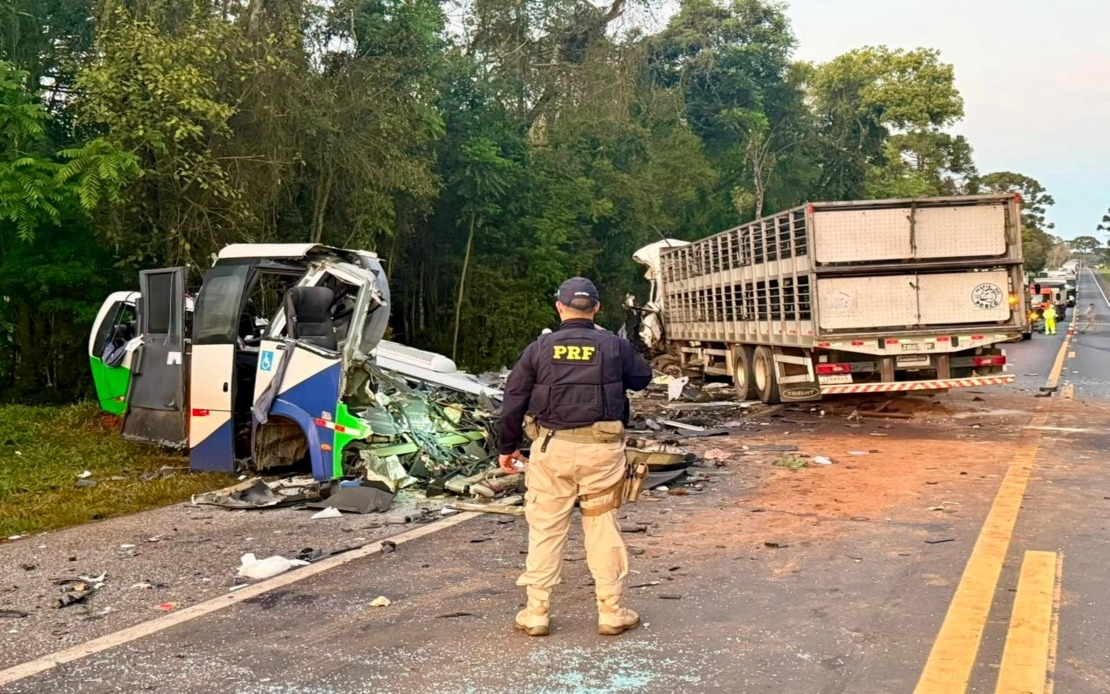
A devastating collision between a minibus and a heavy lorry on a national highway in southern Brazil has claimed 23 lives, marking one of the deadliest road accidents in the Paraná region. The incident unfolded early Wednesday morning near Ipiranga in the Campos Gerais locality when the minibus, operated by the health service and transporting patients, struck the oncoming lorry in a catastrophic head-on impact that left little chance for survival.
According to preliminary investigation findings, authorities believe the lorry driver may have drifted across the centre line into the opposing traffic lane, directly into the path of the minibus carrying vulnerable hospital patients. The exact sequence of events that led to this momentary loss of control remains under active investigation as accident reconstruction specialists examine evidence at the scene. The minibus was en route to medical facilities in the greater Curitiba metropolitan area, approximately 200 kilometres distant from the accident site, transporting individuals who were already in fragile health conditions.
The fatalities comprised a tragic cross-section of passengers: thirteen women, eight men, and two children, alongside the lorry operator whose vehicle precipitated the collision. Beyond those who perished at the scene or shortly thereafter, an additional five individuals sustained serious injuries and required emergency hospital admission. The scale of casualties underscores the brutal physics of highway collisions at speed, particularly when one vehicle lacks the protective structure of a passenger car and carries vulnerable occupants.
The accident location near Ipiranga represents a particularly hazardous stretch of the national highway network connecting multiple regions throughout southern Brazil. This critical transportation artery functions as a two-lane road throughout significant portions of its route, creating inherent dangers when vehicles must share opposing lanes of traffic. The absence of divided highways, acceleration lanes, or modern safety infrastructure across much of this corridor has long been identified as a contributing factor to serious accidents in the region, yet infrastructure improvements remain incomplete.
Emergency responders completely sealed the accident site for several hours while rescue teams retrieved victims and accident investigators began their preliminary examinations. The closure of this major transport artery caused widespread disruption to regional traffic flows and delayed other vehicles attempting passage through the Campos Gerais region. The extended closure reflected both the scale of the disaster and the meticulous nature of initial investigations aimed at preserving evidence and understanding causation.
The Paraná State Secretariat for Public Security, responsible for coordinating emergency response and preliminary findings, emphasized that investigations continue into the precise circumstances surrounding the collision. Officials have declared three days of state mourning in recognition of the unprecedented loss of life. This official gesture reflects the gravity of the incident within the regional context and acknowledges the broader community impact of such a catastrophic transportation failure.
For Malaysian readers, this tragedy illustrates a sobering reality facing many developing and middle-income nations across Southeast Asia and Latin America alike. Many regional highways in Malaysia and neighbouring countries operate under similar constraints—limited lanes, inadequate safety infrastructure, and heavy traffic volume mixing patient transport, commercial vehicles, and passenger cars. The Paraná accident demonstrates how systemic deficiencies in road design and safety standards can amplify the consequences when driver error occurs, transforming a momentary lapse into mass casualties.
The vulnerability of medical transport operations deserves particular attention. These minibuses and ambulances carry patients whose health conditions may already compromise their ability to withstand trauma, yet they frequently traverse highways designed decades ago without modern safety features. In Malaysia, as in Brazil, improving safety protocols for health service transport remains an ongoing challenge requiring coordination between transport authorities, health ministries, and road safety agencies.
The incident also highlights broader questions about driver fatigue, vehicle maintenance standards, and regulatory oversight on commercial highways. Whether the lorry driver's lane drift resulted from fatigue, mechanical failure, or momentary inattention, the consequences proved catastrophic. Transport safety experts across the region continue advocating for mandatory rest periods, vehicle inspection protocols, and enhanced driver training standards as essential components of comprehensive road safety frameworks.
Moving forward, highway authorities in Paraná face renewed pressure to accelerate infrastructure modernization, particularly on this critical national corridor. Discussions will likely intensify regarding divided highway construction, improved drainage systems to prevent skidding hazards during wet weather, better lighting, and clearer lane markings. Such improvements require substantial investment but become increasingly justifiable when measured against the human and economic costs of preventable accidents.
For policymakers and transport safety advocates across Southeast Asia, the Paraná disaster reinforces an essential principle: road safety represents not merely a technical concern but a fundamental public health imperative demanding sustained political commitment and resource allocation. The 23 lives lost represent families devastated, communities grieving, and a stark reminder that transportation infrastructure investments directly determine whether people arrive safely at their destinations.

