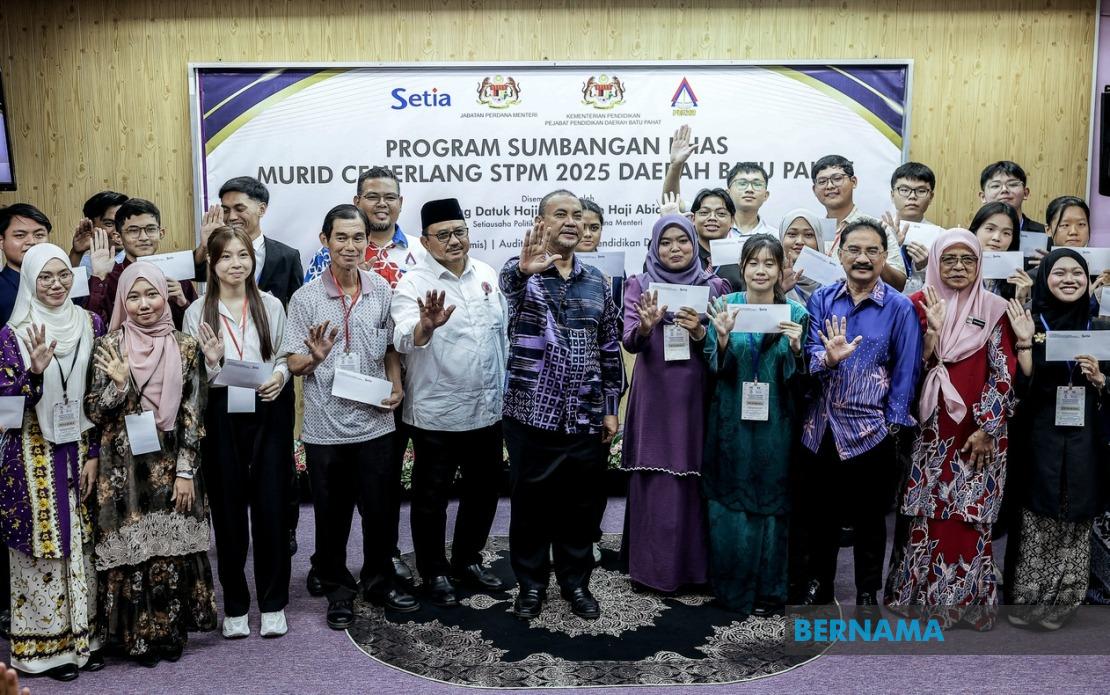
The Prime Minister's Office has distributed special contributions to 214 outstanding STPM students across Batu Pahat district, marking a renewed government focus on recognising academic excellence at the pre-university level. The awards ceremony, held at the Batu Pahat District Education Office, represented a significant acknowledgement of the achievements of these 2025 cohort graduates, drawn from 16 secondary schools throughout the district. The initiative underscores the government's commitment to celebrating educational success and providing tangible support to high-performing students at a critical juncture in their academic journeys.
Datuk Azman Abidin, Political Secretary to the Prime Minister, explained that the contribution scheme serves a dual purpose: to honour students who have demonstrated exceptional academic performance and to motivate them as they prepare for the next phase of their education. The awards were presented with the explicit intention of reinforcing the importance of maintaining high academic standards whilst simultaneously inspiring younger cohorts to pursue similar levels of excellence. This targeted approach reflects a broader policy shift towards identifying and nurturing top talent at the secondary school level, where such encouragement can prove transformative in students' career aspirations.
According to Azman, the government views this contribution programme as an expression of its commitment to educational empowerment and as a practical demonstration of state support for deserving students. Beyond the immediate financial benefit, the initiative carries symbolic weight, signalling that academic achievement is valued and rewarded at the highest levels of government. The contributions are positioned not merely as financial handouts but as recognition of hard work and intellectual dedication, a distinction that matters significantly for young Malaysians navigating the competitive landscape of tertiary education entry.
The scope of the programme underscores its seriousness: spanning 16 secondary schools within a single district suggests comprehensive coverage rather than a token gesture. Schools represented include institutions such as SMK Tun Sardon in Rengit and SMK Tun Ismail, which serve diverse student populations across Batu Pahat. This breadth of participation ensures that recognition reaches across different school communities, potentially creating positive ripple effects throughout the district's secondary education system as other students witness their peers' achievements being celebrated.
One of the recipients, 20-year-old Afida Auni Airulnizam from SMK Tun Sardon, reflected on the award's significance beyond its monetary value. She articulated how the recognition served as both validation of her efforts and motivation to continue advancing her academic pursuits at tertiary level. Afida's aspiration to study sports science reveals the diversity of fields represented among these high achievers, suggesting that the STPM cohort encompasses not only traditional academic routes but also specialised degree pathways. Her acknowledgement of her older brother's university presence as an inspiration highlights the family dynamics that often underpin educational achievement in Malaysian households, where sibling examples and family expectations create powerful motivational structures.
Similarly, Muhd Ammar Firdaus Mohd Fadzil, a 20-year-old former SMK Tun Ismail student, emphasised the practical utility of the contribution in alleviating the financial pressures associated with tertiary education preparation. For many Malaysian families, the transition from secondary to higher education involves substantial costs—application fees, entrance examination preparation materials, and initial college or university expenses. The contribution programme thus addresses a real pain point in the educational pathway, demonstrating governmental awareness of the financial anxieties that can impede talented students' progress.
Azman indicated that the contribution programme remains dependent on available government funding and is not yet a permanent fixture of the annual education calendar. This provisional status suggests ongoing discussions within government circles about budgetary allocation and programme sustainability. However, the explicit statement that the government intends to expand the initiative to other districts indicates clear policy direction and suggests confidence in the scheme's effectiveness as an educational incentive mechanism. Such expansion would eventually reach substantially larger numbers of students across Malaysia, multiplying the motivational impact across the nation's secondary school system.
The Batu Pahat initiative reflects broader trends in Southeast Asian education policy, where governments increasingly seek to identify and support gifted students early in their academic careers. In the Malaysian context, where competition for places in public universities remains intense and the stakes for school-leavers are exceptionally high, formal recognition of achievement serves important psychological and motivational functions. The awards communicate clearly to recipients and their peers that academic excellence is a pathway to governmental recognition and support, potentially influencing study habits and educational aspirations among younger secondary school cohorts.
The programme also carries implications for educational equity and talent development across Malaysia. By identifying and supporting high achievers from diverse school backgrounds—both urban and rural institutions are represented in Batu Pahat—the initiative helps prevent talent wastage and supports the development of human capital across the nation. This inclusive approach contrasts with systems where recognition and support concentrate within elite schools, potentially helping to distribute opportunities more equitably across the secondary education landscape. For a country seeking to maximise its intellectual resources and compete effectively in a knowledge-driven global economy, such broad-based talent recognition and support carries significant strategic value.
The awards also reflect evolving conversations about the STPM qualification itself. As the country's primary pre-university programme, the STPM occupies a crucial position in Malaysia's educational pipeline, yet it has faced periodic scrutiny regarding its relevance and burden on students. By explicitly celebrating STPM achievers, the government reaffirms the qualification's value and importance, countering perceptions that alternative pathways such as matriculation or international baccalaureate hold greater prestige. This symbolic endorsement of STPM could prove important for supporting the qualification's sustainability as Malaysia navigates ongoing debates about educational reform.
Looking forward, the success of the Batu Pahat awards ceremony will likely influence how the government structures similar recognition programmes in other districts. The practical lessons learned—regarding distribution mechanisms, publicity strategies, and motivational messaging—will inform the planned expansion. Additionally, tracking the subsequent university placement and academic performance of these award recipients could provide valuable data regarding the effectiveness of such recognition schemes in actually influencing educational outcomes and career trajectories. For Malaysian policymakers concerned with optimising the nation's human capital development, such evidence will be crucial in justifying ongoing investment in recognition and incentive programmes for academic achievers.

