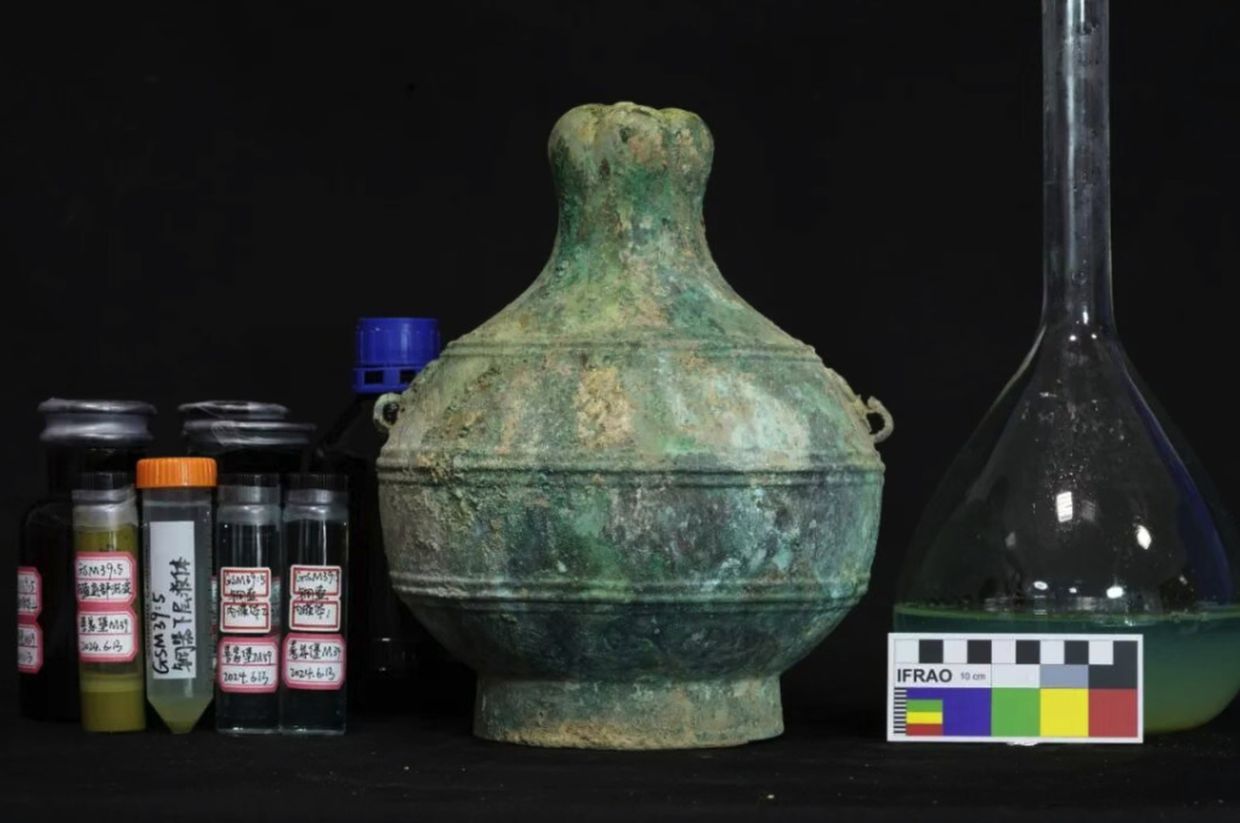
Archaeologists working along the ancient Qin Great Wall in northwestern China have uncovered a bronze wine vessel so perfectly preserved that it offers an unprecedented window into the drinking culture and agricultural practices of border communities during the Warring States period. The discovery at Shanjiabao cemetery, situated just two kilometres from the fortified wall near Guyuan in Gansu province, contained approximately 3,740 millilitres of ancient wine that remained largely intact within its sealed container—making it the most complete and information-rich wine relic from the Qin state yet reported publicly in China.
The 170-kilometre stretch of Qin Great Wall is studded with military installations, garrison points, and fortified settlements that housed soldiers and their families during an era of constant territorial competition. Among 183 tombs excavated at Shanjiabao, 179 belonged to the Qin cultural tradition, suggesting the cemetery served as a burial ground for military personnel and civilians residing within these defensive posts. This context suggests the wine vessel belonged to someone of substance—possibly a soldier of rank or an administrator—whose family deemed the luxury item significant enough to include in his burial goods for the afterlife.
The bronze vessel itself exemplifies the sophisticated engineering of Qin craftsmen. Shaped like a garlic bulb, a distinctive hallmark of Qin metalwork, the pot employed a double-layer sealing mechanism featuring a textile inner lining combined with an outer coating of organic clay. This dual-layer approach prevented oxidation and microbial contamination, preserving the liquid's chemical integrity across more than two millennia. Wang Xiaoyang, head of the archaeological project at the Ningxia Institute of Cultural Relics and Archaeology, emphasised that this preservation technique demonstrated remarkably advanced understanding of storage principles among ancient Chinese craftspeople.
To decode the precise recipe and production methods, researchers sent samples to Northwest University for comprehensive chemical analysis. The investigation identified 24 distinct compound types within the liquid, including organic acids and their derivatives, amino acids, and carbohydrates—a chemical signature that provided detailed information about the wine's composition and aging process. The distribution pattern of organic acids matched that of artificially aged yellow wine, confirming that the beverage was grain-based rather than derived from grapes or other fruits, a distinction crucial to understanding regional brewing traditions.
Starch residue analysis proved particularly revealing about the agricultural resources available to border communities. Researchers determined that over 92 per cent of the starch originated from broomcorn millet, indicating that garrison areas near the wall cultivated this hardy grain extensively. The reliance on broomcorn millet rather than rice reflects the environmental realities of northern China, where millet and foxtail millet thrive in drier climates unsuitable for the water-intensive rice cultivation practised in southern regions. This geographical distinction shaped distinct brewing traditions across China, with each region adapting fermentation techniques to locally available crops.
The discovery fills a significant archaeological void in understanding Warring States-period winemaking within the Ningxia region specifically. Previous scholarship acknowledged that China ranked among the world's earliest societies to develop alcoholic beverages, with accumulating evidence of ancient brewing practices unearthed across numerous sites. Yet detailed knowledge of how garrison communities along the frontier actually produced wine remained fragmentary. This Shanjiabao find provides concrete material evidence of the actual grains, fermentation chemistry, and storage methods employed by people living in one of ancient China's most strategically important zones.
The implications extend beyond mere archaeological curiosity. For Malaysian and Southeast Asian readers, this discovery illuminates how ancient societies adapted food production and processing to environmental constraints—a theme relevant to contemporary discussions about sustainable agriculture in tropical and subtropical regions. The Qin garrison's reliance on hardy, locally-adapted millet crops offers historical precedent for crop selection strategies suited to specific climates, a consideration increasingly important as climate variability challenges modern agriculture across Asia.
Moreover, the careful burial practice of including fine wine reflects values that transcended military hierarchy or economic status. The act of provisioning the deceased with a cherished bronze vessel filled with carefully produced wine speaks to beliefs about continuation beyond death and the importance of comfort in the afterlife—cultural patterns that would have resonated across many ancient Asian societies. Archaeological evidence increasingly reveals that such practices were not peculiar to Chinese civilisations but represented widespread human responses to mortality and spirituality.
The technological sophistication evident in the vessel's double-seal design and the refined understanding of fermentation chemistry it implies challenge simplistic narratives about ancient societies as technologically primitive. These Qin craftspeople possessed genuinely advanced knowledge of materials science, understood principles of anaerobic preservation, and commanded production techniques sophisticated enough to create beverages that improved with age. The fact that wine was valuable enough to accompany a person into death, and that families invested resources in producing or acquiring such goods, indicates the economic and cultural importance of fermented beverages in frontier communities.
Future research will likely focus on attempting to recreate the Qin brewing process based on the chemical data now available. Such experimental archaeology can illuminate not only the taste and qualities of ancient wine but also the labour requirements, production timelines, and skill levels necessary to create such beverages. Understanding these practical dimensions may reveal something about the daily lives, work patterns, and social organisation of people stationed at one of history's most formidable defensive structures.
The Shanjiabao cemetery wine vessel ultimately represents more than an archaeological curiosity or a footnote in the history of viticulture. It embodies the lives of people living in challenging frontier conditions, their ingenuity in working with available resources, their engagement with sophisticated technologies, and their beliefs about what mattered enough to preserve beyond death. In revealing the preferences and practices of ancient border communities, it reconnects modern readers across Asia with distant ancestors who faced their own environmental and social challenges with remarkable creativity.

